
Start Advertising

Amsterdam draws thousands of international professionals each year. And we’re not referring to tourists alone! For example, The Global Move’s latest report counts hundreds of relocation-friendly tech roles in Amsterdam alone, the highest concentration in the Netherlands and one of the most prominent in the world.
Expats and professionals head there for a great balance between pay and lifestyle. Average salaries sit around €55,000, and the 30% ruling allows qualifying expats to receive up to 30% of their gross salary tax-free for the first five years. Still, for a city so in demand by tourists, students, professionals, and well, expats, the first challenge most newcomers face is finding somewhere to live, since the rental market is among the tightest in Europe.
For expats arriving with a signed contract but no local address, Amsterdam serviced apartments have become the most practical way to settle in without months of flat-hunting. We’ll cover a bit of that here.
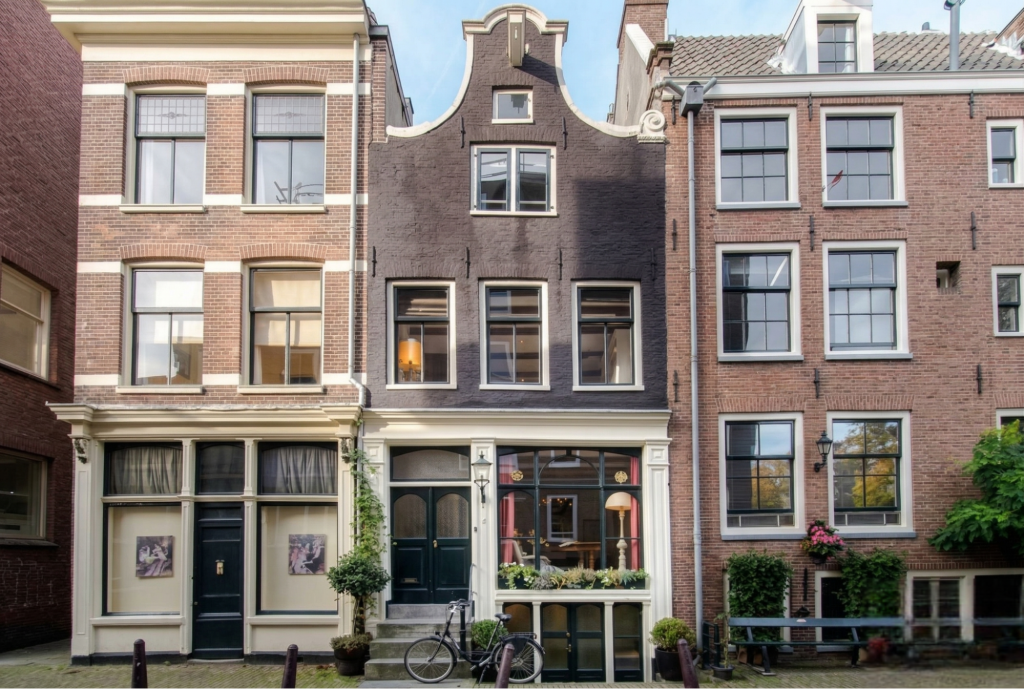
Why the traditional route is hard for newcomers
If you’re just casing whether to move to the Netherlands, here’s how things look in 2026. Amsterdam’s private rental sector shrank in 2025 as landlords sold properties or withdrew them from the market following new rent regulations. At Relocate.me, we regularly speak with engineers who have relocated, and from their accounts, open viewings in popular areas attract twenty to thirty applicants for a single property (this is, of course, anecdotal evidence).
Expats face extra hurdles when they move to the Dutch capital and want to secure their housing. Most landlords require a BSN (citizen service number), a Dutch bank account, and proof of income at three to four times the monthly rent. A recent arrival has none of these. That’s why expats get creative, or rely on their employers for a solution. For example, a Senior Software Engineer who relocated a few years ago from Australia to join Picnic in Amsterdam, needed temporary accommodation for his first month while he searched for a flat.
If you want to know how much your savings will last, Relocate.me’s Amsterdam cost of living breakdown puts total monthly costs for a single person at around €3,114. (Adding a hotel that costs €120 to €180 a night quickly wipes out any savings, yes.)
A very good workaround are serviced apartments.
What a serviced apartment gives you
A serviced apartment comes fully furnished with a working kitchen, high-speed internet, bed linen, and all utilities included in the monthly rate. A new arrival moves in with a suitcase and starts a normal routine the same day. All the pictures you’re seeing in this blog are from serviced apartments!
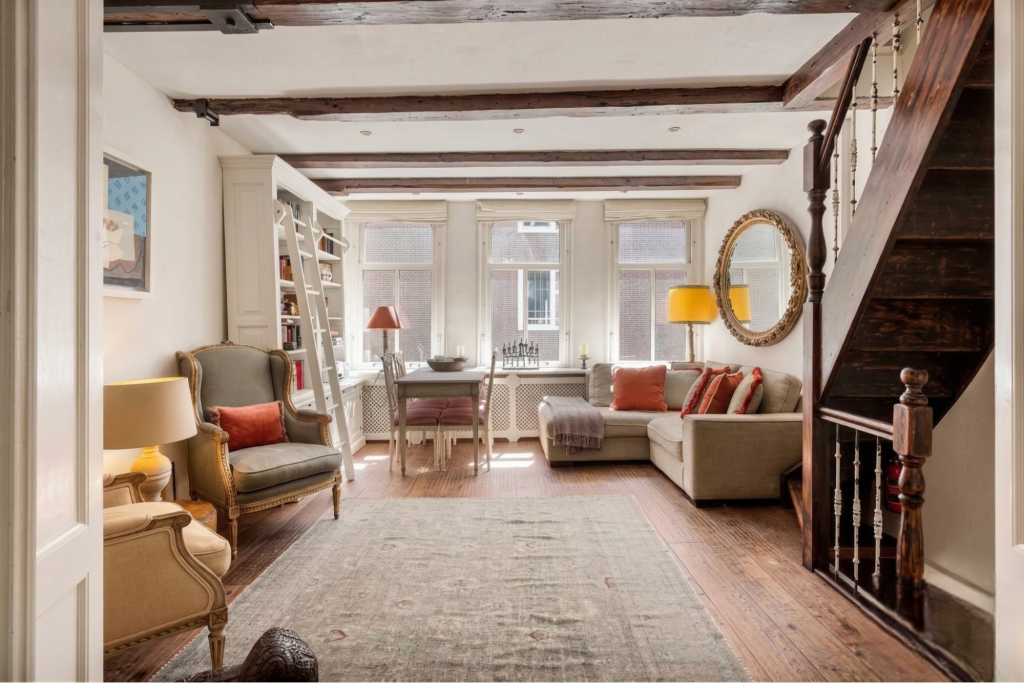
So yes, fully-functional flats where you can land on and start doing your normal life. Some benefits of serviced apartments include:
- Registering with the municipality. Most serviced apartment providers handle the paperwork so tenants can obtain a BSN quickly. Without a BSN, a Dutch bank account, health insurance, and government services all remain out of reach.
- Flexible contract lengths. Providers like City Retreat, which has operated in Amsterdam since 2012, offer contracts from two months. Contracts run month to month after the initial period. A note for expats: This serviced apartments leasing provider offers indefinite contracts. This means their tenants can stay as long as they need (not just for a fixed term).
- All-inclusive pricing. One payment covers rent, gas, water, electricity, and internet. Monthly costs stay predictable throughout the stay.
What each option costs: Renting in Amsterdam in 2026
Ok, now that you know what a serviced apartment is, you’ll want to compare what other options in Amsterdam cost. We did the research for you! This is a breakdown for 2026.
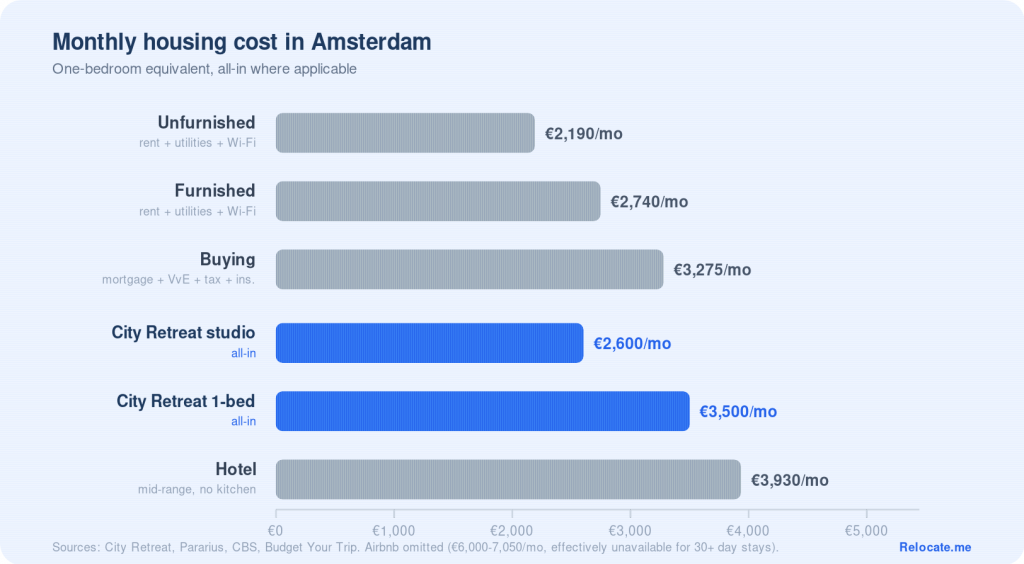
In 2026, serviced apartments leasing businesses typically publish all-inclusive monthly rates: a studio starts at €2,600, a one-bedroom at €3,500, a two-bedroom at €4,500, and a three-bedroom at €5,400. Those figures cover rent, utilities, Wi-Fi, furnishings, linen, and a professional deep-clean before arrival. That looks steep next to the average unfurnished one-bedroom at €1,900. But, the gap closes fast once the full picture comes into view.
Unfurnished private rental. The €1,900 base rent covers bare walls. Add €205 to €330 for utilities, €40 for internet, and €3,000 to €5,000 for basic furniture and appliances. Most landlords require a deposit of two months’ rent (€3,800). Before any of that, an expat needs to find the flat. Pararius data shows supply fell through 2025, and the search takes weeks to months.
During that time, a mid-range Amsterdam hotel at €131 per night runs to €3,930 per month. Two months of hotel plus furniture adds €10,860 to €12,860 before the first month’s rent is due.
Airbnb. Amsterdam used to cap short-term rentals at 30 nights per year per host, and that limit made Airbnb’s somewhat attractive to expats. But, very recent and influential changes are here: From April 2026, that limit has dropped to 15 nights in high-demand areas like the city centre and De Pijp. Where listings exist, nightly rates for a one-bedroom average around €200 to €235. A full month runs to €6,000 to €7,050. And it looks like you cannot register with the municipality with this path.
Buying. The average Amsterdam home costs €640,338. Prices rose 8.6% across the Netherlands in 2025. A thirty-year mortgage at 3.7% works out to roughly €2,950 per month in principal and interest. Add VvE fees averaging €161, property tax, and insurance, and total monthly housing costs land between €3,200 and €3,350. Upfront costs exceed €17,000: the 2% transfer tax alone is €12,807, plus notary fees, a mandatory valuation, and a sworn interpreter for non-Dutch speakers. Relocate.me’s buying guide covers each step.
The nitrogen crisis has stalled roughly 23,000 homes since 2019, and new supply remains scarce. Tip: some software engineers at Picnic found success in nearby cities like Utrecht, 25 minutes by train from Amsterdam Centraal, where prices sit well below the Amsterdam average.
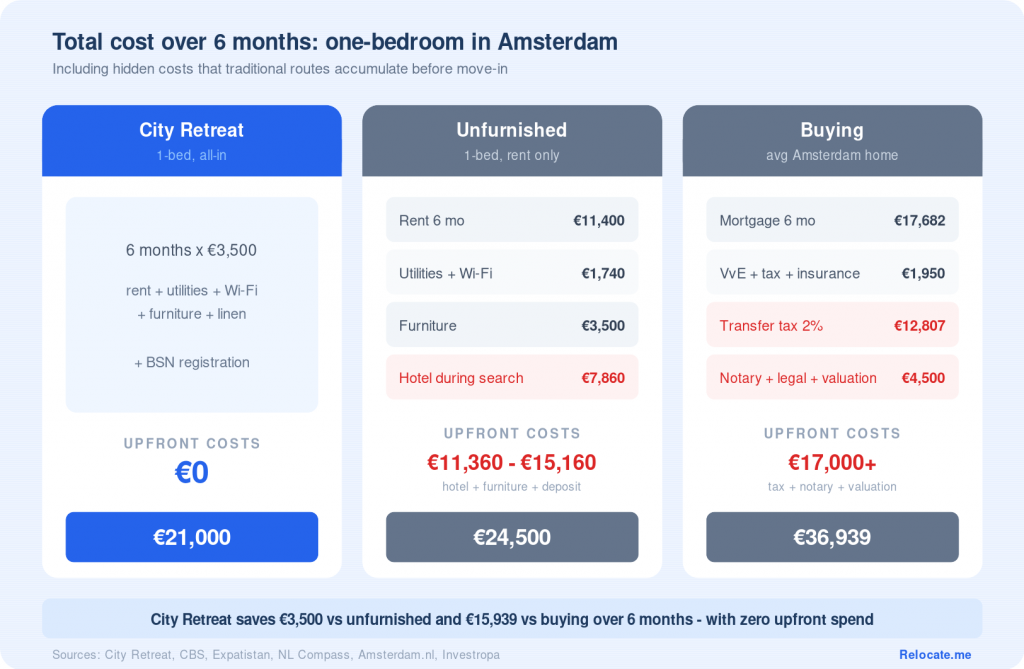
Over a six-month stay, a City Retreat one-bedroom totals €21,000. The unfurnished route totals roughly €24,500 once you add hotel costs during the search, furniture, utilities, and internet. For stays under eight months, the serviced apartment matches or beats the traditional route on total cost, and every month comes with full flexibility to leave on 30 days’ notice.
Where to base yourself: Real opinions from expats in 2026
Alright, it’s hard to describe something different about each neighbourhood without repeating ad nauseam what the whole internet and tourism sites say. That’s why we chose to do something a bit different. We sourced real opinions from residents and expats and compiled them below so you can have a look at what each Amsterdam neighbourhood offers in 2026. Read on:
De Pijp. $$. Arguably, and take this with a grain of salt, Amsterdam’s most cosmopolitan neighbourhood. Home to the Albert Cuyp Market and dozens of international restaurants. Popular with younger expats who want a lively social scene and easy cycling access to the centre. Although some residents online note that the area feels heavily gentrified (then again, which neighbourhood hasn’t gentrified by now?!), that density of international residents is exactly what makes it easy to build a social circle from day one.
Jordaan. $$$. Narrow streets, independent galleries, and a village-like atmosphere inside the canal ring. One of Amsterdam’s most sought-after postcodes. Quiet enough to live in and full of character year-round. Although residents online point out that apartments here run small, the trade-off is living inside the canal belt with everything Amsterdam offers on your doorstep.
Oud-West. $$. Vondelpark on the doorstep and leafy streets (on springtime of course.) A favourite among families and professionals who want space without leaving the centre behind. Residents online describe the area as well-connected to cinemas, green spaces, and the city centre.
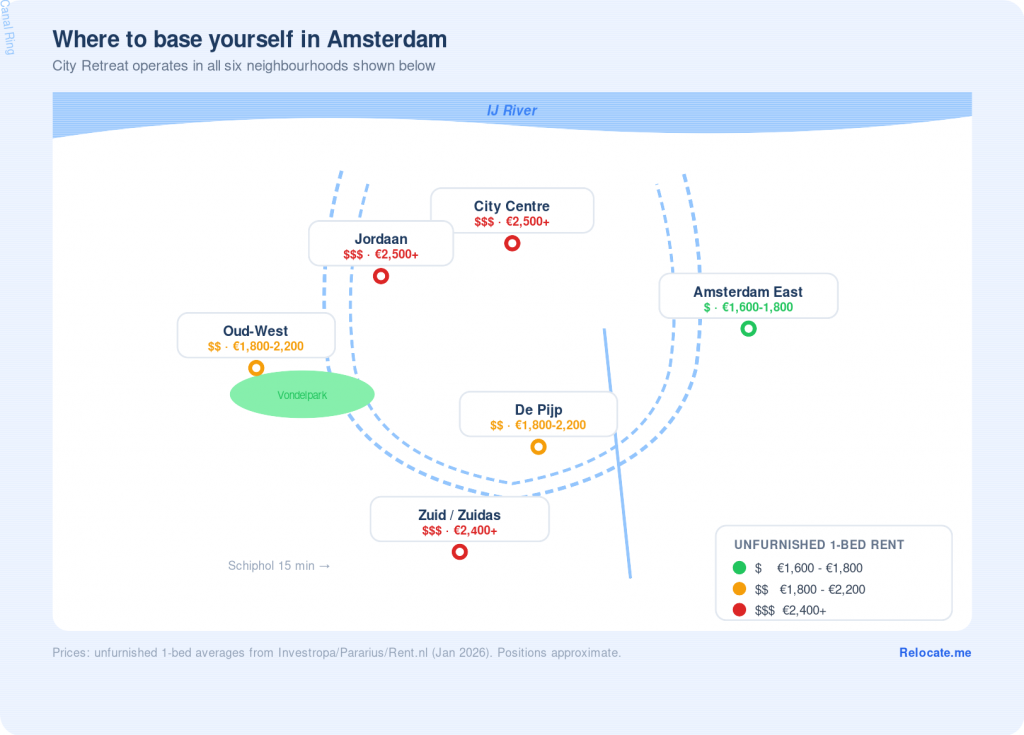
Amsterdam Zuid and Zuidas. $$$. The financial and corporate district. Home to major multinationals and well-connected to Schiphol. Many expat families settle here for the proximity to international schools. Users online highlight clean streets and easy access to Vondelpark. Also, some travellers point out, this neighbourhood is near the Leidseplein area (really sounds like that rock band!) which is jammed full of bars and nightclubs and just by the Rijksmuseum.
Amsterdam East. $. Artis Zoo, Oosterpark, and a growing craft coffee and food scene. Excellent value compared to the canal ring, and increasingly popular with younger expats. Fifteen minutes by bike to the centre. Long-term residents online call Javastraat their favourite street in the city, and others describe it as a quieter De Pijp with far fewer tourists.
City Centre and Canal Ring. $$$. The historic core. UNESCO-listed canal houses within steps of everything Amsterdam offers. Rents run higher, but a serviced apartment here puts a newcomer at the heart of the city from day one.
Some serviced apartments leasing businesses operate across all six of these neighbourhoods. That means renters can pick an area right away that fits their budget, lifestyle, and where they work.
Find a long-term stay in the Netherlands with a job
Many expats use a serviced apartment as a temporary home for two to six months while they get to know the city and look for a long-term place to live. Amsterdam’s current market rewards patience. When someone signs a quick permanent lease, they often end up in a neighborhood they don't know well or at a price that is based on speed rather than value.
For the broader logistics of a move, Relocate.me’s Netherlands guide covers visas, work permits, and how to register for healthcare. The Netherlands salary guide and Dutch tax calculator help estimate net pay before committing to a monthly rent figure.
Start with a serviced apartment, take time to learn the market, and move into a long-term rental or even a purchase once the right neighbourhood and price point become clear. The pressure comes off, and the decisions get better.
Since we’re here, the best way to move and live in the Netherlands (and find a long-term place to live) is actually with a relocation-friendly job. You can browse the companies that hire in the Netherlands, and then help expats move there, and also subscribe to The Global Move to find your next job. Good luck! 🤞
Subscribe to our Substack newsletter!

Get the latest visa news and tips on all things relocation delivered straight to your inbox.
Subscribe

Shoot us an email with your inquiry at [email protected].