
Start Advertising

If you want to break into Big Tech and get a job there in 2026, and you’re located outside the main tech hubs (for example, you’re living in Brasília and you wish you lived in Silicon Valley), you still have a chance to do it if you market yourself properly and if you partner up with the right allies.
Since that’s no easy feat, we’ll be offering very concrete ways so that engineers can break into Big Tech, a package that probably includes living in countries that require hard-to-obtain visas but have high salaries (Silicon Valley again, but also Germany, to cite a different example).
By the end of this article, if you’re a software engineer working in your home country with roughly four years of experience in your field, you should have a very specific playbook for how to approach your first move into Big Tech in a bigger market. If you have fewer than four years of experience, we invite you to keep on reading, since there are pathways ready for you.
A look into the Big Tech job market in 2026
A few years ago, several colleagues researched how many tech jobs were available in the world. Their results were quite optimistic: They concluded that there were 1.7 million open tech positions, many for software engineers, worldwide, while for the US, the estimated number of active tech job postings was roughly 400,000. For a total population of, the same article reported, around 30 million developers on Earth, these were quite interesting numbers. Even if these figures don’t account for layoffs (in 2026 alone, according to the website layoffs.fyi, more than 300 tech companies have decided to lay employees off), it meant (and it means) that there’s open space for professionals who want to pursue careers in tech. Unfortunately, it seemed like 2025 was less auspicious and tech roles began to cool down.
Fast-forward to 2026, and according to data from Investopedia and Indeed, software engineering roles are making a comeback. Software developer job postings have gone up by almost 21% since February 2025, when they were at their lowest point.
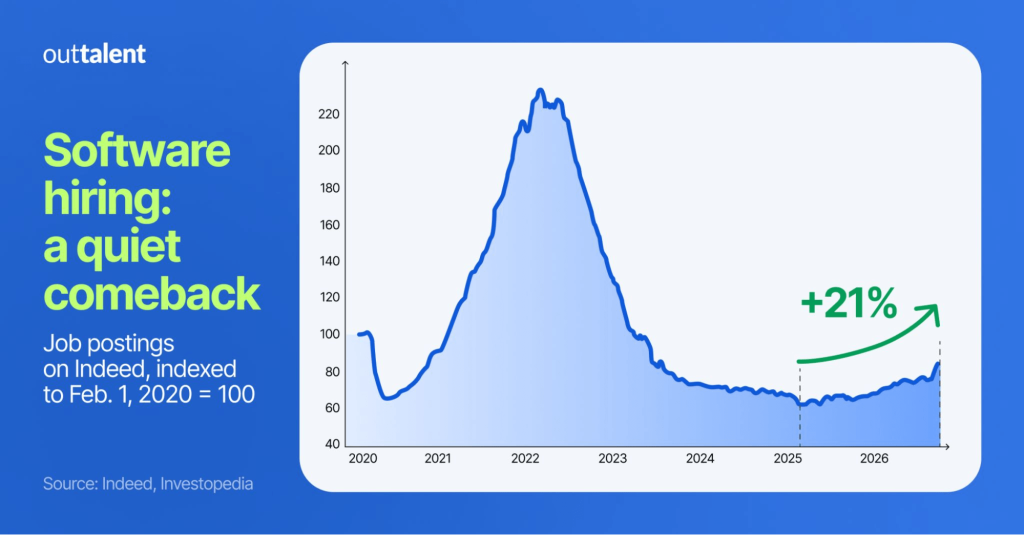
These figures are backed up by specific examples. Since early 2025, some companies have changed their stances on AI replacing jobs. Klarna, for example, has decided to hire employees back (after claiming that AI was enough to replace them), and other companies have simply kept up their hiring pace. In 2026, Stripe, for example, has dozens of open tech roles, and we haven’t found evidence of any considerable layoffs in the past 18 months. Actually, they’re in a net hiring phase at the time of writing.
But these jobs are not for everyone
But if you’re reading this, you, of course, realize that these positions are off limits to many engineers who might wish for them. Here at Relocate.me we take pride in curating and promoting relocation-friendly jobs, and anyone looking for software engineering jobs from abroad knows that, compared to jobs that a US citizen can apply for, these are simply more limited. Software engineers who don’t have the legally required permits can’t simply apply their way into a Silicon Valley job. (Or they can apply, yes, but they won’t get far.)
Fortunately, there are some practical ways to prepare your approach for getting into Big Tech, even if you don’t have the right permits at the moment. Working with specialized partners, such as Outtalent, can serve as one of those pathways.
Practical ways to break into Big Tech from abroad
These are some ways we’d suggest you look into if you’re living in India, Brazil, Nigeria, Indonesia, Türkiye, Kyrgyzstan (and the list goes on), you have four years of experience as a SWE, and you want to have a job at MAANG and other companies overseas. This is 2026 advice!
Get a job that helps you relocate to your new market
This is the maxim for expats who wish to relocate:
The best way to move and work abroad is with a job that helps you relocate.
This is still true in 2026 and still true for, let’s say, the United States (even if certain visas are experiencing political turbulence). Once you have a job in a new country, like the United States, you’re in a better position to further target that market (e.g., you’re working in Dallas, and now you want to aim for Silicon Valley) as a candidate and try to land a job at a Big Tech firm.
Unfortunately for candidates, this process is not as straightforward as it sounds. For example, if the job that got you to the United States was sponsoring your visa, then you can’t easily switch jobs without some paperwork mastery (and a good deal of luck). But there are exceptions. If you were to relocate to the Netherlands (or Spain, for that matter) with a job and then managed to obtain citizenship (which is demanding, but feasible), you’d then be in a position to switch jobs, including to MAANG companies, without losing your special status.
If you want to find jobs that help you relocate, you can check for international jobs at Relocate.me or subscribe to the curated newsletter The Global Move, which we’ll cover next.
Try the internal mobility path
You can try to get a MAANG or Big Tech job in your current country and then convince your employer to allow you to relocate. This is called internal mobility, and it’s still somewhat restrictive for a reason many readers will point out: In many countries, there isn’t even a single posting for a job in a MAANG company.
Find alternative ways to relocate
In our newsletter The Global Move (where our founder periodically shares relocation-friendly and remote-friendly jobs for engineers), we have featured some alternative ways to move and work abroad, like, for example, pursuing talent visas. Software engineers can also try job seeker visas in certain countries that have MAANG or Big Tech offices. With job seeker visas, engineers can “buy some time” in the target country so that they can land there and try to get the job. But they’ll be running against the clock.
It’s a visa, we suspect, that might have worked wonderfully in 2021, when the hiring rush for software developers was at its most intense. In 2026, when it’s completely common for application processes to last more than six months, job seeker visas are a tad too risky.
Work with a partner like Outtalent that helps you get the Big Tech job
If you read the first point on this list, the one that said, “the best way to move abroad is with a job”, you might have sighed. It’s a phrase that’s, of course, easier said than done. Perhaps one of the best ways to take it from a thought to a reality is to collaborate with specialized allies with whom you can partner up and get that job.
One of those allies is Outtalent. Outtalent, founded by Tilek Mamutov, the first Google employee from Kyrgyzstan (who knows exactly how hard it is to break into Big Tech if you’re not from the USA), has a clear mission:
Helping engineers from emerging markets land big tech jobs.
Their program trains software engineers to pass interviews at MAANG and get jobs at big companies, and they aren't concerned about passports or backgrounds. Since their foundation in 2019, Outtalent has helped skilled, international software engineers get jobs at Meta, Stripe, Uber, NVIDIA, Amazon, Google, and other prominent employers. Their fellows have received more than 270 qualifying offers at top tech companies, and right now, they have no fewer than 230 graduates from a dozen different countries.
Outtalent's combination of a bootcamp and a strong referral network
Outtalent is a YC-backed company that couples a bootcamp (their main program) with connections with other software engineers who work for the biggest tech players out there.
If you browse through Outtalent’s website, you’ll notice they prepare you for the interview stage at those big names, but also that they have a network of fellows. The founding team and many candidates who got to break into Big Tech remain connected to these companies and as such they act as a referral network of professionals. Cold applying is by no means obsolete in 2026, but considering the proliferation of “spray and pray” applications and the well-founded fear about applications being AI-generated fakes, a referral network means, for a recruiter, an extra dose of peace of mind. The person they’re about to interview actually has credentials.
Outtalent is aware of this advantage. Tilek Mamutov, their founder, knows it very well: He had a harder time getting a job at Google in the US than the second, third, fourth (and so on) of his countrymen, because he was doing the referrals for them. In an email to Relocate.me, they said that “many Big Tech companies don’t actively consider international applicants, but an internal referral may help exceptional candidates get considered.”
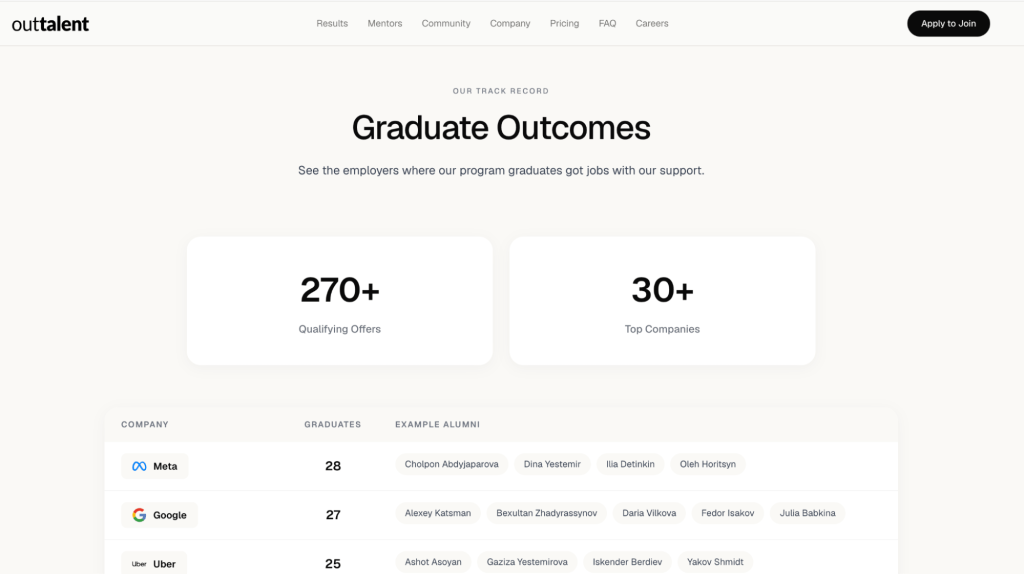
Beyond having a polished resume and studying the interview questions, landing in their network is also part of marketing yourself to appeal to Big Tech. When you’re presenting yourself with an endorsement from software engineers with a similar background, you’re also contributing a high-quality note to your “candidate brand”, if you'll allow us the expression.
Networking can be affordable
Outtalent is inherently affordable (their founder certainly can relate to devs who need to relocate and can’t pull off financial miracles). One of their 1–2 month programs, the Genesis program, costs $500. Their Atlas and Horizon programs run at $900/month. After graduating from Atlas or Horizon (two of their programs), candidates get 3 months of job application support and access to their 100+ referral network.
To learn more about the specifics on pricing, their programs, and the backgrounds of the people who run it, head to Outtalent’s site →
Break into Big Tech with the help of Outtalent
If you want to break into Big Tech in 2026, and:
- you’re a software engineer with four or so years of experience in your home market,
- you’re a software engineer who’s just starting but still has the specific ambition of working with Stripe or Uber,
- or you’re a developer who made it into Big Tech but was affected by layoffs,
… then Outtalent can help you reach your potential. In 2026, getting the edge over other candidates with small details (like networking or tailored interview prep) is perhaps more important than it was in 2021. But the central advantage of working with Outtalent, maybe, is that they can relate to other engineers from diverse backgrounds who have already grappled with how daunting landing a job in the United States or Germany can be. They certainly experienced it the same way.
You can look up companies that hire internationally or connect with Outtalent today to get the ball rolling and discuss strategies for getting a job in Big Tech abroad.
Subscribe to our Substack newsletter!

Get the latest visa news and tips on all things relocation delivered straight to your inbox.
Subscribe

Shoot us an email with your inquiry at [email protected].